We have compiled a list of manufacturers, distributors, product information, reference prices, and rankings for High Pressure Homogenizer.
ipros is IPROS GMS IPROS One of the largest technical database sites in Japan that collects information on.

High Pressure Homogenizer Product List and Ranking from 8 Manufacturers, Suppliers and Companies | IPROS GMS

Last Updated: Aggregation Period:Feb 18, 2026~Mar 17, 2026
This ranking is based on the number of page views on our site.

High Pressure Homogenizer Manufacturer, Suppliers and Company Rankings

Last Updated: Aggregation Period:Feb 18, 2026~Mar 17, 2026
This ranking is based on the number of page views on our site.

  1. 常光 ナノマテリオ・エンジニアリング事業部 Kanagawa//Industrial Machinery
  2. エスエムテー 本社 Tokyo//Testing, Analysis and Measurement
  3. 三丸機械工業 Shizuoka//Industrial Machinery
  4. 4 同栄商事 Osaka//Trading company/Wholesale
  5. 5 新日本通商 Hyogo//Trading company/Wholesale

High Pressure Homogenizer Product ranking

Last Updated: Aggregation Period:Feb 18, 2026~Mar 17, 2026
This ranking is based on the number of page views on our site.

  1. High-pressure homogenizer, Gorin type エスエムテー 本社
  2. Universal type! Ultra-high pressure homogenizer NAGS100 常光 ナノマテリオ・エンジニアリング事業部
  3. I will explain about the H-type nozzle! 常光 ナノマテリオ・エンジニアリング事業部
  4. Wet-type ultra-high pressure homogenizer "NAGS Series" 常光 ナノマテリオ・エンジニアリング事業部
  5. 5 Mechanism of the ultra-high pressure homogenizer 常光 ナノマテリオ・エンジニアリング事業部

High Pressure Homogenizer Product List

1~30 item / All 39 items

Displayed results

Ultra-high pressure homogenizer, Ranier type

Ultra-high pressure homogenizer, Ranier type

Three-part cylinder block (R type): This unique structure is an example of our excellent technology. By dividing the suction section, discharge section, and plunger section within the cylinder block, we can minimize the risk of damage or cracking of the entire block during operation under adverse conditions and at high pressures exceeding 500 bar. Depending on the application, the pump valve can be changed to a ball valve or a poppet valve (the maximum pressure for poppet valve use is 600 bar). This structure demonstrates its maximum effectiveness when used under high viscosity and ultra-high pressure conditions. This cylinder can also be made in an aseptic specification.

  • Emulsifier/Disperser
  • Homogenizer
  • High Pressure Homogenizer

Added to bookmarks

Bookmarks list

Bookmark has been removed

Bookmarks list

You can't add any more bookmarks

By registering as a member, you can increase the number of bookmarks you can save and organize them with labels.

Free membership registration

Universal type! Ultra-high pressure homogenizer NAGS100

The highest pressure in Japan! 250MPa!

Dispersing, emulsifying, and breaking down are performed at a high pressure of up to 250 MPa. Equipped with an H-type nozzle (for dispersing, emulsifying, and breaking down), the sample is pressurized by a high-pressure pump and passes through the H-type nozzle, allowing for efficient dispersion, emulsification, and breakdown of uniform fine particles. 【Features】 ○ Easy dispersion of nanoparticles ○ Minimal contamination ○ Difficult to reaggregate, stable for a long time ○ Surface condition of the sample remains unchanged ○ Can perform kneading *For details, please download the catalog from the link below.

  • Mixer/agitator
  • High Pressure Homogenizer

Added to bookmarks

Bookmarks list

Bookmark has been removed

Bookmarks list

You can't add any more bookmarks

By registering as a member, you can increase the number of bookmarks you can save and organize them with labels.

Free membership registration

Mass production type! Ultra-high pressure homogenizer NAGS1000

Mass processing of 500 liters per hour! Ultra-high pressure homogenizer for micronizing slurry samples.

We perform dispersion, emulsification, and disintegration under high pressure. Equipped with our uniquely developed H-type nozzle, the sample pressurized by a high-pressure pump passes through the H-type nozzle, allowing for efficient dispersion, emulsification, and disintegration of uniform fine particles.

  • Mixer/agitator
  • High Pressure Homogenizer

Added to bookmarks

Bookmarks list

Bookmark has been removed

Bookmarks list

You can't add any more bookmarks

By registering as a member, you can increase the number of bookmarks you can save and organize them with labels.

Free membership registration

Contract Testing Case: Emulsification of Cosmetic Microparticles

We are creating case studies within the company and making proposals.

The performance of equipment for powder processing (dispersion, emulsification, grinding) cannot be expressed in the catalog. The reason is that the processing methods change depending on the materials used and the intended purpose. So, what indicators should be used for selection? The best way is to look at actual processing examples. In our company, we create internal case studies to explain the technology of our equipment in an easy-to-understand manner for our customers. ● For more details, please download the catalog or contact us.

Added to bookmarks

Bookmarks list

Bookmark has been removed

Bookmarks list

You can't add any more bookmarks

By registering as a member, you can increase the number of bookmarks you can save and organize them with labels.

Free membership registration

Case of commissioned testing processing: Tricalcium phosphate (β-TCP)

Introducing the powder processing data materials of the NAGS series!

The performance of powder processing equipment (dispersion, emulsification, grinding) cannot be expressed in the catalog. The reason is that the processing method changes depending on the materials used and the purpose. So, what indicators should be used for selection? The best way is to look at actual processing examples. Tricalcium phosphate is actively used as a material for artificial bones and teeth, so it is necessary to create a material with high strength. An ultra-high-pressure homogenizer from Soko is effective for making particles finer. [Contents of Powder Processing Data Materials] - Comparison photos before and after processing - Particle size distribution data *Please download and view the data materials for processing examples from the link below.

Added to bookmarks

Bookmarks list

Bookmark has been removed

Bookmarks list

You can't add any more bookmarks

By registering as a member, you can increase the number of bookmarks you can save and organize them with labels.

Free membership registration

Case of entrusted testing processing: Escherichia coli

It plays an active role in the pretreatment of protein purification by grinding bacterial cells such as E. coli.

It can also be applied to the micronization of new compounds from pharmaceutical companies. From research models to mass production machines, by performing "processing condition output," it becomes possible to achieve highly reproducible results.

Added to bookmarks

Bookmarks list

Bookmark has been removed

Bookmarks list

You can't add any more bookmarks

By registering as a member, you can increase the number of bookmarks you can save and organize them with labels.

Free membership registration

Contracted Testing Case: Graphene

Collaborated with overseas research institutions to develop materials and successfully achieved the exfoliation of graphite!

The utilization of the new material "graphene," which is strong and excels in conductivity and thermal dissipation, is gaining attention. However, there are still challenges regarding the production costs and mass production of single-phase graphene, making it difficult to widely deploy it as a material for manufacturing. In this context, research is being conducted to apply mechanical shear forces to inexpensive graphite bulk, efficiently peeling off layers to produce graphene. The Italian national research institute IIT (Istituto Italiano di Tecnologia) has focused on this manufacturing method early on and has adopted our ultra-high-pressure homogenizer (NAGS100) in the mechanical exfoliation process. Currently, multilayer graphene is being stably produced from graphite bulk and is being applied in various applications. In the future, mass production is being advanced, and inexpensive, high-quality graphene ink is expected to be sold worldwide.

  • スクリーンショット 0031-02-19 午後6.07.02.png
  • Secondary Cells/Batteries
  • High Pressure Homogenizer

Added to bookmarks

Bookmarks list

Bookmark has been removed

Bookmarks list

You can't add any more bookmarks

By registering as a member, you can increase the number of bookmarks you can save and organize them with labels.

Free membership registration

Contracted Test Processing Case: Fuel Cell

Achieving high output of PT catalysts!

Delivery to Tokai University. "CNTs, which have a large surface area and high electrical conductivity, are expected to be applied as supports. In our laboratory, we achieve high performance of Pt catalysts and high output of fuel cells by performing a pretreatment that uniformly disperses CNTs in water using an ultra-high-pressure homogenizer."

  • Lithium-ion battery
  • High Pressure Homogenizer

Added to bookmarks

Bookmarks list

Bookmark has been removed

Bookmarks list

You can't add any more bookmarks

By registering as a member, you can increase the number of bookmarks you can save and organize them with labels.

Free membership registration

Mechanism of the ultra-high pressure homogenizer

Make it into a slurry and perform dispersion.

A "slurry" mixed with powder, solvent, and a dispersant to prevent re-agglomeration is injected into the sample tank. A pressure of up to 250 MPa is applied to the material within the device, and the materials are made to collide head-on using our unique "H-type nozzle" to achieve dispersion. We refer to passing the sample through the device once as a "pass." By repeating this "pass" multiple times, the materials are dispersed to sizes ranging from "microns to several tens of nanometers," and in a "uniform" manner.

  • Powder Molding Machine
  • High Pressure Homogenizer

Added to bookmarks

Bookmarks list

Bookmark has been removed

Bookmarks list

You can't add any more bookmarks

By registering as a member, you can increase the number of bookmarks you can save and organize them with labels.

Free membership registration

I will explain about the H-type nozzle!

Simultaneously achieving 'bringing out the quality of the materials' and 'easy maintenance'.

The "H-type nozzle" realizes the "three types of dispersion" unique to Joko! Within the "ultra-high pressure homogenizer" system, this part is made of "diamond." The material pushed through by a high-pressure pump passes through this specially crafted nozzle. And then, 1. Generation of jet flow Shearing occurs within the unit, resulting in a liquid phase jet flow. 2. Collision of materials When the sheared materials merge, they collide head-on. 3. Joko's unique vortex jet flow The vortex jet flow further enhances the effect. During depressurization, cavitation occurs while dispersing, efficiently extracting the effects of dispersants and other additives.

  • Powder Molding Machine
  • High Pressure Homogenizer

Added to bookmarks

Bookmarks list

Bookmark has been removed

Bookmarks list

You can't add any more bookmarks

By registering as a member, you can increase the number of bookmarks you can save and organize them with labels.

Free membership registration

[Information] Explanation of the NAGS series mechanism.

The characteristics of H-type nozzle dispersion processing are "damage-free" and the image of "loosening rather than crushing."

This document explains the mechanism of the "NAGS series." The general terms are "ultra-high pressure homogenizer" and "wet jet mill." It is a device that injects slurry materials at ultra-high pressure (up to 250 MPa) through a diamond processing nozzle to nano-size and nano-disperse various materials. Please take a moment to read it. [Contents] ■ What is Joko's nano-sizing device (NAGS series)? ■ Joko's unique design philosophy and H-type nozzle (NJP unit) *For more details, please refer to the PDF document or feel free to contact us.

Added to bookmarks

Bookmarks list

Bookmark has been removed

Bookmarks list

You can't add any more bookmarks

By registering as a member, you can increase the number of bookmarks you can save and organize them with labels.

Free membership registration

Introducing Case Studies: What Nano-Micronization Involves with the NAGS Series

The miniaturization and high performance of electronic devices such as batteries and MLCCs will rely on the nanomization of constituent materials as a key technology!

This document introduces processing examples related to nanomicroization involved in the NAGS series. Nanomicroization is a key technology for miniaturizing and enhancing the performance of electronic devices such as batteries and MLCCs (multi-layer ceramic capacitors) through the nanomicroization of constituent materials. Additionally, there is a demand for uniform particle processing that does not contain impurities. New processing examples from the industrial sector are also included. [Contents] ■ What is nanomicroization ■ New processing examples in the industrial sector *For more details, please refer to the PDF document or feel free to contact us.

Added to bookmarks

Bookmarks list

Bookmark has been removed

Bookmarks list

You can't add any more bookmarks

By registering as a member, you can increase the number of bookmarks you can save and organize them with labels.

Free membership registration

Introduction of case studies on data processing

Examples of the crushing treatment of zinc oxide, which requires micronization into the nanoscale to achieve transparency, are widely featured!

This document is a collection of case studies on processing conducted by Joko Co., Ltd. "Disaggregation" is a treatment that loosens and micro-sizes aggregates of primary particles. For example, according to manufacturer data, materials with a primary particle size of 30 nm are aggregated to a state of 5 μm, which is then loosened and micro-sized. The characteristic front collision force of the Joko nozzle powerfully micro-sizes the material. Additionally, "crushing" is a treatment that literally crushes primary particles to achieve micro-sizing. This process demonstrates the greatest advantage of media-free processing, which is minimal material damage. [Published Cases] ■ Zinc oxide "Disaggregation" ■ Barium titanate "Disaggregation" ■ Nickel hydroxide "Crushing" ■ Titanium diboride "Crushing" *For more details, please refer to the PDF document or feel free to contact us.

  • Other contract services
  • High Pressure Homogenizer

Added to bookmarks

Bookmarks list

Bookmark has been removed

Bookmarks list

You can't add any more bookmarks

By registering as a member, you can increase the number of bookmarks you can save and organize them with labels.

Free membership registration

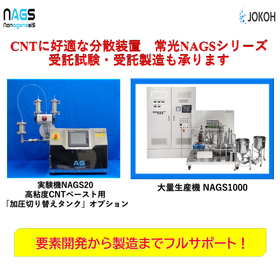
We are Joko, a manufacturer of wet dispersers. We also accept contract testing and contract manufacturing.

We support everything from elemental research of high-functional materials to contract manufacturing and production line establishment with our nano-micronization and nano-dispersion device "Joko NAGS"!

The NAGS series of ultra-high pressure homogenizers for wet-type nano-dispersion machines by Chokko is a highly versatile device capable of processing a wide range of materials, including ceramics, metals, high aspect ratio materials such as CNTs and CNFs, and emulsions. We also offer contract testing services and can assist your company in the development of high-performance materials. Please feel free to consult with us. 【Desktop Experimental Machine NAGS20 Features】 ■ Capable of handling a minimum of 8ml ■ Can accommodate high concentration and high viscosity samples ■ Electric desktop model achieving high-pressure processing at 200MPa ■ Extremely low contamination suitable for high-purity samples ■ Compatible with organic solvents (Most organic solvents, including acetone, toluene, and NMP, can be used) The "NAGS100" and "NAGS1000" are also equipped with our uniquely developed H-type nozzle, making scale-up from the "NAGS20" easy. Additionally, we accept requests for "CNT dispersion" and "contract testing and manufacturing." Detailed information is available in PDF and video format through the related links. *For more details, please refer to the PDF materials or feel free to contact us.

Added to bookmarks

Bookmarks list

Bookmark has been removed

Bookmarks list

You can't add any more bookmarks

By registering as a member, you can increase the number of bookmarks you can save and organize them with labels.

Free membership registration

Numerous CNT dispersion achievements! The Joko dispersion machine NAGS series takes a step forward.

A must-see for those considering CNT (carbon nanotube) dispersion! We can create CNT dispersion solutions tailored to your needs. Please try it out with our contract testing first!

In recent years, CNTs have rapidly expanded their applications into various fields, including secondary batteries, semiconductors, and the enhancement of resin materials through mixing. On the other hand, CNTs are one of the difficult-to-disperse materials among high-performance materials. Using our years of experience, Joko will assist you in discovering the optimal conditions for generating dispersions tailored to your needs. 【Please feel free to contact us with the following concerns】 ■ CNT concentration → We will assist you in examining higher concentrations with an optimal equipment configuration for high viscosity. ■ Solvent types → We can conduct examinations with various solvents. Examples include water, NMP, IPA, ethyl acetate, and MEK. ■ Dispersant types → We can consult based on the compatibility with the type of CNT and solvent. (We have a small amount of various dispersants available, so preliminary discussions are also welcome.) ■ Pre-dispersion treatment → We can assist you with pre-dispersion before the main dispersion using NAGS, based on consultation. ■ Processing pressure and number of passes → We will work together to consider processing pressure and number of passes to achieve a dispersion state that minimizes damage to CNT fiber length, from a state of partial dispersion to complete dispersion. Please try our contract testing first.

Added to bookmarks

Bookmarks list

Bookmark has been removed

Bookmarks list

You can't add any more bookmarks

By registering as a member, you can increase the number of bookmarks you can save and organize them with labels.

Free membership registration

Sanmaru Machinery Industry Co., Ltd. Company Profile

Specialized manufacturer of high-pressure homogenizers (dispersion machines/devices and emulsifiers) - Sanmaru Machinery Industry.

Sanmaru Machinery Industry Co., Ltd., a specialized manufacturer of high-pressure homogenizers, leverages over 90 years of experience and advanced technology to provide a wide range of homogenizers for improving the quality of food products such as dairy, beverages, and seasonings, as well as chemicals, pharmaceuticals, and chemical products. High-pressure homogenizers are machines that can emulsify and grind, reducing particles in liquids to a smaller, uniform size, thereby enhancing product stability and functionality. 【Three Major Features of Sanmaru Machinery Industry】 ○ Specialized manufacturer of high-pressure homogenizers (dispersion and emulsification machines) → Advanced technology based on over 90 years of experience and achievements ○ Energy-efficient design → High operational efficiency with recommended energy-saving motors ○ 24/7 emergency response → Available to respond anytime as long as there are customer requests For more details, please contact us or download the catalog.

  • Homogenizer
  • tank
  • Emulsifier/Disperser
  • High Pressure Homogenizer

Added to bookmarks

Bookmarks list

Bookmark has been removed

Bookmarks list

You can't add any more bookmarks

By registering as a member, you can increase the number of bookmarks you can save and organize them with labels.

Free membership registration

Device "High-Pressure Homogenizer"

Development of an emulsification and dispersion mechanism for a homogenizer based on a new concept!

The "High-Pressure Homogenizer" is a device with a maximum operating pressure of 150 MPa (1,500 bar) and a standard processing capacity of 3,000 l/h. The homogenizer effect is increased by 45%, and the same effect can be achieved with a 30% reduction in conventional processing pressure. Additionally, the homogenizing pressure is controlled by pneumatic pressure (Max. 0.6 MPa), making it simple and easy to operate, while ensuring stable homogenizing pressure. 【Features】 ■ 45% increase in homogenizer effect ■ Same effect with a 30% reduction in conventional processing pressure ■ Stability of the machine and long lifespan of components ■ No sources of contamination ■ Low noise level below 75 dB(A) *For more details, please refer to the catalog or feel free to contact us.

  • Homogenizer
  • High Pressure Homogenizer

Added to bookmarks

Bookmarks list

Bookmark has been removed

Bookmarks list

You can't add any more bookmarks

By registering as a member, you can increase the number of bookmarks you can save and organize them with labels.

Free membership registration

Ultra-high pressure homogenizer LAB1000/2000

The sample is refined by cavitation effects due to ultra-high pressure.

It is a device for testing, research, and experimentation that can emulsify, disperse, and crush small samples and expensive materials, as it is capable of handling small amounts of processing.

  • Emulsifier/Disperser
  • Homogenizer
  • High Pressure Homogenizer

Added to bookmarks

Bookmarks list

Bookmark has been removed

Bookmarks list

You can't add any more bookmarks

By registering as a member, you can increase the number of bookmarks you can save and organize them with labels.

Free membership registration

Case study of commissioned testing: Dispersion of barium titanate.

We are creating case studies internally and making proposals.

The performance of powder processing equipment (dispersion, emulsification, grinding) cannot be expressed in the catalog. The reason is that the processing method changes depending on the materials used and the intended purpose. So, what indicators should be used for selection? The best way is to look at actual processing examples. In dispersion, for materials used in electronic components, a type of ceramic is required for miniaturization in small multilayer ceramic capacitors, where finer and more uniform particles are sought. ● For more details, please download the catalog or contact us.

Added to bookmarks

Bookmarks list

Bookmark has been removed

Bookmarks list

You can't add any more bookmarks

By registering as a member, you can increase the number of bookmarks you can save and organize them with labels.

Free membership registration

Contract Testing Case: Crushing and Disintegration of α-Alumina

We are creating case studies within the company and making proposals.

The performance of powder processing equipment (dispersion, emulsification, grinding) cannot be expressed in the catalog. The reason is that the processing method changes depending on the materials used and the intended purpose. So, what indicators should be used for selection? The best way is to look at actual processing examples. Alumina has a variety of properties, including chemical stability, high melting point, high mechanical strength, high hardness, and high electrical insulation resistance. Therefore, it is used in a wide range of fields, such as ceramic materials for pottery, mechanical parts, electronic components, and grinding and polishing materials. ● For more details, please download the catalog or contact us.

Added to bookmarks

Bookmarks list

Bookmark has been removed

Bookmarks list

You can't add any more bookmarks

By registering as a member, you can increase the number of bookmarks you can save and organize them with labels.

Free membership registration

Contract Testing Case: Carbon Nanotubes

We are creating case studies within the company and making proposals.

The performance of equipment for powder processing (dispersion, emulsification, grinding) cannot be expressed in the catalog. The reason is that the processing method changes depending on the materials used and the intended purpose. So, what indicators should be used for selection? The best way is to look at actual processing examples. Carbon nanotubes are materials made of carbon graphene sheets arranged in single or multi-layer coaxial tubes, possessing strength several times that of steel, excellent heat and chemical resistance, and high electrical and thermal conductivity, making them a dream material. However, their poor dispersibility poses challenges when applied to various uses. In contrast, the ultra-high pressure homogenizer from Joko can efficiently disperse carbon nanotubes in a short time without damaging them. For more details, please download the catalog or contact us.

Added to bookmarks

Bookmarks list

Bookmark has been removed

Bookmarks list

You can't add any more bookmarks

By registering as a member, you can increase the number of bookmarks you can save and organize them with labels.

Free membership registration

Case of commissioned testing processing: Zinc oxide (applied in pigments, pharmaceuticals, cosmetics, etc.)

Introducing the powder processing data materials of the NAGS series!

The performance of powder processing equipment (dispersion, emulsification, grinding) cannot be expressed in catalogs. The reason is that the processing methods change depending on the materials used and the intended purpose. So, what indicators should be used for selection? The best approach is to look at actual processing examples. Zinc oxide is used in various applications such as pigments, pharmaceuticals, and cosmetics. In recent years, its properties as a semiconductor have attracted attention, and its application in transparent conductive film materials is anticipated. To enhance transparency, finer particles are required. 【Content of Powder Processing Data Materials】 - Comparison photos before and after processing - Particle size distribution data *Please download and view the data materials of processing examples from the link below.

Added to bookmarks

Bookmarks list

Bookmark has been removed

Bookmarks list

You can't add any more bookmarks

By registering as a member, you can increase the number of bookmarks you can save and organize them with labels.

Free membership registration

Case of commissioned testing processing: Pollen

If it's a regular light, it "disperses without damaging the material"! Just like "the skin of an orange."

Delivery to Chitose Institute of Science and Technology. (Photo provided by Chitose Institute of Science and Technology)

  • Processing Contract
  • High Pressure Homogenizer

Added to bookmarks

Bookmarks list

Bookmark has been removed

Bookmarks list

You can't add any more bookmarks

By registering as a member, you can increase the number of bookmarks you can save and organize them with labels.

Free membership registration

Contracted Testing Processing Case: Cellulose Nanofiber

There is a proven track record of mass production models both domestically and internationally!

The material that is said to significantly expand in market size in the future is CNF. With Joko's ultra-high-pressure homogenizer, it is possible to directly generate CNF using only "pulp" and "water." It can also be applied to materials like "bamboo." The ultra-high pressure exerted by the triple-piston plunger dramatically changes the material properties. Of course, it is also compatible with high-viscosity CNF.

  • Processing Contract
  • High Pressure Homogenizer

Added to bookmarks

Bookmarks list

Bookmark has been removed

Bookmarks list

You can't add any more bookmarks

By registering as a member, you can increase the number of bookmarks you can save and organize them with labels.

Free membership registration

Wet-type ultra-high pressure homogenizer "NAGS Series"

Challenging "difficult nano-micronization and nano-dispersion" with high technical capabilities! We will assist in solving our customers' challenges - we also accept contract testing and contract processing.

The "NAGS Series" is a wet-type ultra-high pressure homogenizer that supports the development of high-performance materials for our customers. The "NAGS20" is equipped with our uniquely developed H-type nozzle, which allows samples pressurized by a high-pressure pump to pass through the H-type nozzle, efficiently achieving uniform dispersion, emulsification, and disintegration of fine particles. It is also capable of handling high-concentration (below 60%) and high-viscosity (below 100,000 cP) samples, making it suitable for processing small amounts of samples. It is an electric tabletop model that achieves high-pressure processing of 200 MPa. The "NAGS100" and "NAGS1000" are also equipped with our uniquely developed H-type nozzle, making it easy to scale up from the "NAGS20." [NAGS20 Features] - Capable of handling a minimum of 8 ml - Suitable for high-concentration and high-viscosity samples - Achieves high-pressure processing of 200 MPa in an electric tabletop model - Extremely low contamination suitable for high-purity samples - Compatible with organic solvents (most organic solvents such as acetone, toluene, and NMP can be used) *For more details, please refer to the PDF document or feel free to contact us.

Added to bookmarks

Bookmarks list

Bookmark has been removed

Bookmarks list

You can't add any more bookmarks

By registering as a member, you can increase the number of bookmarks you can save and organize them with labels.

Free membership registration

[Information] Features of the NAGS Series: Explanation of Differences from Bead Mill Machines

Large diameter nozzle for 'less clogging'! Medium and large machines are fully customizable!

This document explains the features of the "NAGS Series" and the differences compared to bead mills. It includes "Features of the Joko NAGS Series" and "Organization of Features Compared to Bead Mills." Please take a moment to read it. [Contents] ■ Features of the Joko NAGS Series ■ Organization of Features Compared to Bead Mills *For more details, please refer to the PDF document or feel free to contact us!

Added to bookmarks

Bookmarks list

Bookmark has been removed

Bookmarks list

You can't add any more bookmarks

By registering as a member, you can increase the number of bookmarks you can save and organize them with labels.

Free membership registration

[Data] Examples of NAGS Utilization in Research Institutions

Introducing numerous practical examples! We are collaborating on various research and development projects with universities and research institutions around the world.

This document is a collection of case studies showcasing the use of NAGS in research institutions. It includes examples such as "Graphene Manufacturing Research at Italy's IIT" and "High-Performance Research on Pt Catalysts for Fuel Cells at Tokai University." Please take a moment to read it. [Contents] ■ NAGS Use Case in Research Institution (1) ■ NAGS Use Case in Research Institution (2) ■ NAGS Use Case in Research Institution (3) ■ NAGS Use Case in Research Institution (4) *For more details, please refer to the PDF document or feel free to contact us.

Added to bookmarks

Bookmarks list

Bookmark has been removed

Bookmarks list

You can't add any more bookmarks

By registering as a member, you can increase the number of bookmarks you can save and organize them with labels.

Free membership registration

Constant Light's solution for CNT dispersion.

We are currently offering case studies that solve problems related to CNT dispersion!

This document introduces case studies that address concerns related to CNT dispersion. Do you have any issues such as: "I want to control the dispersion state according to the application," "I want to break it apart as little as possible," "My equipment often gets clogged," etc.? We will solve your concerns regarding CNT (carbon nanotube) dispersion with our solutions! *For more details, please refer to the PDF document or feel free to contact us.

Added to bookmarks

Bookmarks list

Bookmark has been removed

Bookmarks list

You can't add any more bookmarks

By registering as a member, you can increase the number of bookmarks you can save and organize them with labels.

Free membership registration

Optimal for CNT dispersion - Choko Super High Pressure Homogenizer NAGS Series

We boast a wealth of achievements in CNT dispersions for various applications. From research use to mass production, we offer a full lineup. Please leave contract testing and contract manufacturing to us!

CNT has finally entered the practical application stage. Our company has received requests from a wide range of customers, including actual CNT users, CNT manufacturers, CNT dispersion liquid manufacturers, as well as dispersant manufacturers and material trading companies. Our ultra-high-pressure homogenizer, the "NAGS series," achieves precise dispersion while maintaining CNT length, which is difficult to achieve with bead mills or ultrasonic methods. Additionally, the "NAGS series" features the same type of dispersion unit across all devices, making it easy to scale up from small-scale development phases to large-scale manufacturing. If you have any of the following concerns, please feel free to contact us: - I want to control the dispersion state suitable for my application. - I want to loosen the material as much as possible without cutting it. - I want to conduct research and development that can directly lead to future large-scale processing. - I would like to consider a highly convenient device that is less prone to clogging. For more details, please refer to the PDF document or feel free to contact us.

Added to bookmarks

Bookmarks list

Bookmark has been removed

Bookmarks list

You can't add any more bookmarks

By registering as a member, you can increase the number of bookmarks you can save and organize them with labels.

Free membership registration

Suitable for CNT dispersion - Choko Super High-Pressure Homogenizer NAGS Series

Disassemble without cutting, suitable for high viscosity, we propose an experimental device ideal for CNT dispersion - switchable pressurized tank system - Try it out with our contract testing!

The practical application of CNTs is advancing in the latest battery and electronic device fields. It is difficult to achieve a precise dispersion that maintains fiber length with bead mills and ultrasonic homogenizers. From the perspective of utility and scale-up, the only option for CNT dispersion is the ultra-high-pressure homogenizer. 《Do you have any of the following issues?》 - Want to control the dispersion state suitable for the application - Want to loosen without cutting as much as possible - Want to consider a device that is less likely to clog and easy to use - Want to conduct research and development that can be directly linked to future mass processing The NAGS20 switchable pressurized tank system solves these problems. ◆ Achieves a suitable dispersion state with minimal damage through a uniquely designed H-type nozzle ◆ Less likely to clog with a large diameter nozzle ◆ Capable of processing high-viscosity CNT paste (dispersion liquid) with increased concentration ◆ No need for sample replacement for each pass or tank switching ◆ Continuous processing with just the operation of a switch lever allows efficient prototype work ◆ Easy scale-up as it comes standard with the same H-type nozzle as medium and large machines Please try it out with contract testing first. * For more details, please refer to the PDF document or feel free to contact us.

Added to bookmarks

Bookmarks list

Bookmark has been removed

Bookmarks list

You can't add any more bookmarks

By registering as a member, you can increase the number of bookmarks you can save and organize them with labels.

Free membership registration